A sharp pain running from your lower back down your leg, or a stiff neck that sends tingling into your arm, can make ordinary days exhausting. These are classic signs of a slipped disc, and most people recover without surgery. This guide explains the symptoms, your options for slipped disc treatment in Hyderabad, and when to seek help.
Quick answer: Most slipped discs improve with staying gently active, physiotherapy, medication and posture correction over several weeks. Surgery is considered only if severe pain, weakness or numbness continues despite treatment. Loss of bladder or bowel control, or sudden leg weakness, is an emergency: go to a hospital immediately.
Written by the Sri Ram Hospitals clinical content team and medically reviewed by Dr. Srinivas Boga, Consultant Orthopedic Surgeon (MBBS, MS Orthopaedics, DNB Orthopaedics).
What Is a Slipped Disc?
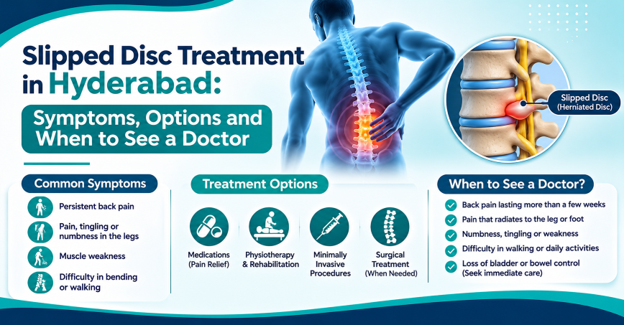
The bones of your spine are cushioned by discs, each with a firm outer ring and a soft, gel-like centre. In a slipped disc, also called a herniated or prolapsed disc, some of that soft centre pushes through a weak spot in the outer ring. The bulge can press on a nearby nerve and cause pain, numbness or weakness along that nerve's path.
A slipped disc most often affects the lower back and the neck.
Common Symptoms of a Slipped Disc
Symptoms vary depending on which disc is affected and whether nearby nerves are compressed. Common symptoms include:
- Lower back or neck pain that worsens when sitting, bending or coughing
- Pain travelling down one leg, often below the knee, or into one arm
- Tingling, pins and needles or numbness in the leg, foot, arm or hand
- Muscle weakness, such as a dragging foot or a weak grip
- Pain that eases when you lie down or change position
What Causes a Slipped Disc?
Discs lose water and flexibility with age, which makes them easier to injure. Common triggers and risk factors include:
- Incorrect heavy lifting: Lifting heavy objects with a rounded back can put additional pressure on spinal discs.
- Prolonged sitting: Sitting for long hours with poor posture, common in desk and IT jobs, can contribute to back discomfort.
- Sudden movement or injury: A sudden twist or a fall may contribute to disc injury.
- Excess body weight: Additional body weight can increase the load on the spine.
- Smoking: Smoking can affect disc health and reduce the supply of nutrients to spinal tissues.
- Family history: Some people may have an increased tendency to develop disc-related problems.
Red Flags: When a Slipped Disc Is an Emergency
Go to an emergency centre immediately if back pain comes with:
- Loss of control over your bladder or bowels
- Numbness around the groin or inner thighs
- Sudden or worsening weakness in one or both legs
- Severe pain after a fall or road accident
These can signal serious pressure on the spinal nerves, which needs urgent treatment. Sri Ram Hospitals provides round-the-clock trauma care in Hyderabad.
How a Slipped Disc Is Diagnosed
Diagnosis starts with your medical history and a physical examination. The doctor checks your reflexes, muscle strength, sensation and how far you can raise your leg before the pain starts.
An MRI scan shows the discs and nerves most clearly and is advised when symptoms are severe, long-lasting or include weakness. X-rays cannot show discs, but they help rule out other causes of back pain, such as fractures or arthritis.
The treating doctor decides which investigations are necessary based on your symptoms and examination findings.
Slipped Disc Treatment Without Surgery
Most patients improve without an operation. A typical treatment plan may include:
Staying Gently Active
Short walks and normal movement usually help more than long periods of bed rest. Activities should be adjusted according to your pain and the advice of your treating doctor.
Medication
Pain relief and anti-inflammatory medicines may be prescribed to help manage symptoms. These should be taken only as directed by a qualified doctor, considering your medical history and other medications.
Physiotherapy
Physiotherapy may include stretching, core strengthening and posture training. The exercises should be selected according to the location of the affected disc, symptoms and physical examination.
Injections
In selected cases, a spinal injection near the irritated nerve may be considered to help manage pain and inflammation. The suitability of injections depends on the individual patient's condition.
Most symptoms settle over several weeks to a few months, though recovery varies from person to person. Avoid forceful back or neck manipulation by untrained practitioners until the cause is confirmed, as it can worsen nerve pressure.
When Is Surgery Needed?
Most slipped disc patients do not require surgery. However, an operation may be considered if:
- Severe leg or arm pain continues after about six to twelve weeks of appropriate treatment.
- Weakness or numbness is getting worse.
- Signs of serious nerve compression appear, which is an emergency.
The most common operation for certain herniated discs is a microdiscectomy, which removes the part of the disc pressing on the nerve.
A trustworthy surgeon explains the benefits and risks before you decide, and a second opinion is always reasonable.
Slipped Disc vs Sciatica
Sciatica is a symptom, not a diagnosis. It describes pain along the sciatic nerve, from the lower back through the buttock and down the leg.
A slipped disc is one of the most common causes, but sciatica can also come from spinal narrowing or muscle tightness. Treatment depends on the cause, which is why an accurate diagnosis matters.
How to Prevent a Slipped Disc
Although not every slipped disc can be prevented, certain daily habits may help support spinal health:
- Take a short walking break every 30 to 45 minutes if you sit for work.
- Lift with your knees bent and the load close to your body.
- Strengthen your core with regular walking, swimming and guided back exercises.
- Maintain a healthy weight and avoid smoking.
- Set up your chair, screen and keyboard so your back stays supported.
Meet Dr. Srinivas Boga: Experience You Can Verify
Dr. Srinivas Boga is a Consultant Orthopedic Surgeon at Sri Ram Hospitals with more than 15 years of experience. He holds MBBS, MS Orthopaedics and DNB Orthopaedics qualifications and treats a wide range of bone, joint and back injuries and disorders.
He begins with careful examination and imaging, recommends non-surgical treatment first where it is appropriate, and explains clearly if surgery or a specialist referral is the better choice. Patients often mention how patiently he explains each step.
Slipped Disc Treatment in Manikonda, Hyderabad: Sri Ram Hospitals
Sri Ram Hospitals welcomes patients with back and neck pain from Manikonda, Puppalaguda, Gachibowli and across Hyderabad. If you are looking for slipped disc treatment in Hyderabad or back pain treatment near Manikonda, our team offers consultation, diagnosis, physiotherapy and follow-up care.
Learn more about us, explore all our orthopedic services, or contact us for directions.
Sri Ram Hospitals
1st Floor, above Apollo Pharmacy,
Pipeline Road, Puppalaguda, Manikonda, Hyderabad, Telangana 500089
Phone and WhatsApp: +91 97010 00220
Book an appointment with Dr. Srinivas Boga today, or visit our contact page for directions and hours.
Frequently Asked Questions
Can a slipped disc heal on its own?
Often the symptoms settle on their own as inflammation reduces and the bulging material shrinks. Pain that is severe or lasting should still be examined by a doctor.
How long does a slipped disc take to heal?
Most people notice improvement within a few weeks, and many recover over two to three months. Recovery varies with the disc affected, your age and how closely you follow the treatment plan.
Is walking good for a slipped disc?
Gentle walking is usually helpful because it keeps the spine moving. Stop and see a doctor if walking increases leg pain, numbness or weakness.
Where is Sri Ram Hospitals located in Hyderabad?
Sri Ram Hospitals is at 1st Floor, above Apollo Pharmacy, Pipeline Road, Puppalaguda, Manikonda, Hyderabad, Telangana 500089, where Dr. Srinivas Boga consults patients. Visit our contact page for directions and hours.
How do I book an appointment with Dr. Srinivas Boga?
Use the online appointment page, message the hospital on WhatsApp at +91 97010 00220, or see our contact page.