Knee pain on the stairs, a stiff shoulder, a back that won’t settle: most of us put up with it for weeks. But bone and joint problems rarely fix themselves, and an early visit to an orthopedic surgeon in Hyderabad often means simpler treatment. This guide explains when to go and what to expect.
Quick answer: See an orthopedic surgeon if bone, joint, muscle or spine pain lasts more than two weeks, follows an injury, or limits walking and daily activity. Go to an emergency centre immediately for a suspected fracture, a deformed limb or a sudden inability to bear weight.
Written by the Sri Ram Hospitals clinical content team and medically reviewed by Dr. Srinivas Boga, Consultant Orthopedic Surgeon (MBBS, MS Orthopaedics, DNB Orthopaedics).
What Does an Orthopedic Surgeon Do?
An orthopedic surgeon is a medical doctor who diagnoses and treats problems of the musculoskeletal system: bones, joints, ligaments, tendons, muscles and the spine. Despite the title, most of the work is not operating. The surgeon examines you, orders X-rays or MRI scans when needed, and recommends the least invasive option that will work. That may be medication, physiotherapy, injections or a brace, and surgery only when those options fall short.
Orthopedic Doctor vs Orthopedic Surgeon: Is There a Difference?
Patients in Hyderabad use the terms orthopedic doctor, ortho specialist, bone doctor and orthopedic surgeon almost interchangeably. A surgeon is trained to operate but manages most patients without surgery, and a good one will say honestly when you do not need an operation.
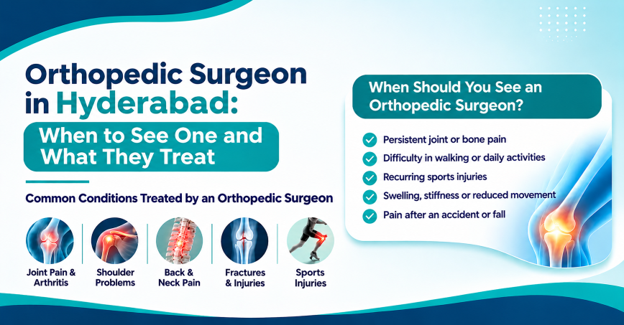
9 Signs You Should See an Orthopedic Surgeon
Book a consultation if you notice any of the following:
- Joint or back pain that lasts longer than two weeks despite rest
- Swelling, stiffness or warmth around a joint
- Pain after a fall, sports injury or road accident
- Difficulty climbing stairs, standing up from a chair or walking
- Knee or hip pain that wakes you at night
- A joint that locks, catches or gives way
- Numbness, tingling or weakness in an arm or leg
- A visible deformity or a limb that looks out of shape
- Reduced movement in the shoulder, elbow, wrist or ankle
Conditions an Orthopedic Surgeon Treats
Common problems include:
- Knee: Arthritis, ACL and meniscus tears, ligament injuries and knee replacement. See our knee injuries and disorders page.
- Hip: Hip arthritis, avascular necrosis, hip fractures and hip injuries and disorders.
- Shoulder: Frozen shoulder, rotator cuff tears and dislocations, covered under shoulder injuries and disorders.
- Back and neck: Slipped disc, sciatica, spinal stenosis and cervical spondylosis, covered under back injuries and disorders.
- Fractures and trauma: Broken bones in adults and children, and accident injuries, covered under fracture care.
- Elbow: Tennis elbow, golfer’s elbow and elbow fractures, covered under elbow injuries and disorders.
- Hand and wrist: Carpal tunnel syndrome, trigger finger and wrist fractures, covered under hand and wrist injuries and disorders.
- Foot and ankle: Plantar fasciitis, sprains, bunions and Achilles tendon injuries, covered under foot and ankle injuries and disorders.
Will You Always Need Surgery?
No. Most patients begin with non-surgical care: rest, anti-inflammatory medication, physiotherapy, targeted exercise, weight management, braces or injections. Surgery is considered when pain continues despite treatment, when a joint is badly damaged, when a fracture must be fixed in position, or when a nerve is under pressure.
A trustworthy surgeon explains your options and risks before you decide, and a second opinion is always reasonable.
Red Flags: Go to Emergency Care Immediately
Do not wait for an appointment if you have:
- A suspected broken bone, or a bone visible through the skin
- A limb that looks bent or out of place
- A sudden inability to walk or bear weight after an injury
- Severe back pain with loss of bladder or bowel control, or sudden leg weakness
- Numbness, or a cold and pale limb, after an injury
Keep the injured area still, avoid moving it, and travel to the nearest trauma centre. Sri Ram Hospitals provides round-the-clock trauma care in Hyderabad.
How to Choose the Best Orthopedic Doctor in Hyderabad
Look beyond advertising. Check these points:
- Qualifications: An MS or DNB in Orthopaedics and valid state medical council registration.
- Relevant experience: Ask how often the surgeon treats your specific condition.
- Honest advice: A good surgeon discusses non-surgical options first.
- Facilities: In-house imaging, physiotherapy and readiness for emergencies.
- Patient reviews: Read for patterns about communication and care, not just star ratings.
- Follow-up care: Rehabilitation support after treatment matters as much as the procedure.
Meet Dr. Srinivas Boga: Experience You Can Verify
Dr. Srinivas Boga is a Consultant Orthopedic Surgeon at Sri Ram Hospitals with more than 15 years of experience. He holds MBBS, MS Orthopaedics and DNB Orthopaedics qualifications, and his areas of expertise include joint replacement, trauma and reconstructive surgery, and fracture care for adults and children.
He confirms the diagnosis through examination and imaging, tries non-surgical treatment first where appropriate, and recommends surgery only when it is clearly the better choice. Patients often mention how patiently he explains each step, including to parents of young children.
What to Expect at Your First Visit
A first appointment usually follows four steps:
- History and examination: You describe your symptoms, and the doctor checks movement, strength and tenderness.
- Imaging, if needed: An X-ray or MRI may be advised to confirm the cause.
- Diagnosis and options: You hear what is wrong and what treatments are available.
- Treatment plan: You leave with clear next steps and a realistic timeline.
Bring earlier scans, reports, your current medicines and any insurance documents.
Orthopedic Surgeon in Hyderabad: Sri Ram Hospitals
Sri Ram Hospitals welcomes patients from across Hyderabad. If you are looking for an orthopedic doctor near Manikonda, our team offers consultation, fracture care, joint replacement and physiotherapy under one roof. Learn more about us, explore all our orthopedic services, or contact us for directions.
Sri Ram Hospitals
Pipeline Road, Puppalaguda, Manikonda, Hyderabad, Telangana 500089
Phone and WhatsApp: +91 97010 00220
Book an appointment with Dr. Srinivas Boga today, or visit our contact page for directions and hours.
Frequently Asked Questions
What is the difference between an orthopedic doctor and an orthopedic surgeon?
In everyday use the terms mean the same specialist. Dr. Srinivas Boga is trained to operate, but most patients are treated without surgery.
Do I need a referral to see an orthopedic surgeon in Hyderabad?
Usually not. You can book directly with Dr. Srinivas Boga for bone, joint and spine concerns, though bringing earlier reports helps the doctor.
Where is Sri Ram Hospitals located in Hyderabad?
Sri Ram Hospitals is located at Pipeline Road, Puppalaguda, Manikonda, Hyderabad, Telangana 500089, where Dr. Srinivas Boga consults patients. Visit our contact page for directions and hours.
How do I book an appointment with Dr. Srinivas Boga?
Use the online appointment page, message the hospital on WhatsApp at +91 97010 00220, or see our contact page.