A slip on the stairs, a football tackle or a road accident: a broken bone can happen in a moment. What you do in the first hour decides how well it heals. This guide explains fracture treatment in Hyderabad, from first aid and healing time to cast versus surgery.
Quick answer: If you suspect a broken bone, keep the area still, do not try to straighten it, and go to an emergency orthopedic hospital for an X-ray. Most fractures heal in about 6 to 12 weeks, though large bones can take several months. Bone through the skin or a deformed limb is an emergency.
Written by the Sri Ram Hospitals clinical content team and medically reviewed by Dr. Srinivas Boga, Consultant Orthopedic Surgeon (MBBS, MS Orthopaedics, DNB Orthopaedics).
Signs of a Broken Bone
A fracture means a bone has cracked or broken, either partly or all the way through. Watch for these warning signs:
- Pain that sharpens when you move the area or press on it
- Puffiness and bruising around the injured spot
- A limb that looks crooked, shorter than usual or twisted
- Difficulty lifting, gripping or putting weight through the limb
- Pins and needles or loss of feeling beyond the injury
First Aid for a Suspected Fracture
- Do not move it: Hold the injured part still and resist the urge to realign the bone.
- Steady the limb: Keep the limb in the position it is in, using a rolled-up towel, a magazine or a padded splint on either side if this can be done safely.
- Stop any bleeding: Press a clean cloth around the edges of the wound, not over exposed bone.
- Cool the area: Use an ice pack wrapped in cloth for 10 to 15 minutes.
- Avoid food and drink if emergency surgery may be needed: Follow emergency medical advice. Avoid rubbing or massaging the injured area.
- Get to a hospital without delay.
Emergency: When to Go to a Trauma Hospital Immediately
Head straight to an emergency orthopedic hospital if you notice any of the following:
- A bone poking through the skin, or bleeding that will not stop
- A joint or limb that is clearly out of shape
- A hand or foot that turns cold, pale or bluish, or loses feeling
- Any suspected injury to the neck, spine or head, in which case the person should not be moved unless there is immediate danger
- A hip or thigh injury after a fall, particularly in older people
Sri Ram Hospitals offers round-the-clock trauma care in Hyderabad for injuries like these.
Common Types of Fractures
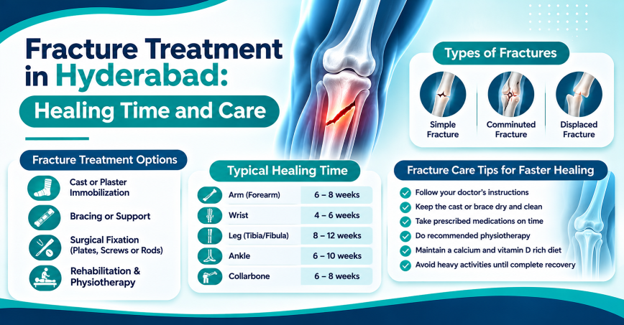
- Closed fracture: The bone breaks without piercing the skin.
- Open (compound) fracture: A broken end pushes through the skin, which raises the risk of infection.
- Displaced fracture: The pieces no longer line up and may need to be repositioned.
- Stress or hairline fracture: A fine crack, usually caused by repeated strain.
- Greenstick fracture: A bend with a partial break, mostly in children whose bones are still soft.
How a Fracture Is Diagnosed
Your doctor will examine the injury, check the circulation and nerves beyond it, and request an X-ray to confirm the break. When the picture is unclear, or the fracture involves a joint, a CT or MRI scan can show more detail.
Cast or Surgery? How Fracture Treatment Is Decided
Casts, Splints and Braces
Casts, splints and braces hold a bone steady while it heals. They work well when the bone is lined up and stable, or when a doctor can reposition it without surgery.
Surgery
Surgery is advised when the pieces have moved apart, the fracture is unstable or open, a joint is involved, or a cast cannot keep the bone in place. Metal plates, screws or rods hold the bone so it heals in the correct position.
For older adults with a broken hip, an operation soon after they are medically fit usually allows an earlier return to walking. Whatever the plan, it is reasonable to ask for a second opinion.
Fracture Healing Time
Healing times differ with the bone involved, your age and how the bone broke. Typical ranges are:
- Fingers, toes and ribs: Roughly 4 to 6 weeks.
- Wrist, forearm and ankle: Roughly 6 to 8 weeks.
- Shin and thigh bones: Around 3 to 6 months, sometimes longer.
- Hip fracture: Several months of rehabilitation.
Smoking, diabetes, a poor diet and low vitamin D can all slow recovery.
Child Fracture Treatment in Hyderabad
Children's bones usually mend faster than adults', but they contain growth plates, areas of developing bone near the ends that need close monitoring. If a growth plate injury is missed, it can interfere with how the bone grows.
Think of a fracture if a child will not use an arm, cries when a limb is touched, or develops swelling after a fall, and arrange an X-ray soon. Most children's fractures heal in a cast, and a few require surgery.
Recovery and Care After a Fracture
- Follow weight-bearing instructions closely, since putting weight on the limb too early can shift the bone.
- Wiggle exposed fingers or toes regularly to help manage swelling, if advised by your doctor.
- Include protein, calcium and vitamin D in your diet, and stay away from tobacco.
- Begin physiotherapy when your doctor says it is time, to restore strength and movement.
Contact your doctor if pain increases, numbness appears, the cast feels too tight, or you develop a fever or discharge from a wound.
Meet Dr. Srinivas Boga: Trauma and Fracture Expertise
Dr. Srinivas Boga is a Consultant Orthopedic Surgeon at Sri Ram Hospitals with over 15 years of experience. His qualifications are MBBS, MS Orthopaedics and DNB Orthopaedics, and his areas of expertise include trauma and reconstructive surgery, fracture care for adults and children, and joint replacement.
He chooses a cast or splint whenever that is enough and advises surgery only when the injury calls for it. Patients frequently mention how patiently he talks them through each step, including parents of young children.
Fracture Treatment in Manikonda, Hyderabad: Sri Ram Hospitals
Sri Ram Hospitals treats fractures and injuries for patients from Manikonda, Puppalaguda, Gachibowli and across Hyderabad. Whether you need a fracture doctor near Manikonda or a trauma hospital in Manikonda for yourself or your child, our team provides assessment, treatment and follow-up care.
You can read more about us, browse our orthopedic services, or contact us for directions.
Sri Ram Hospitals
1st Floor, above Apollo Pharmacy,
Pipeline Road, Puppalaguda, Manikonda, Hyderabad, Telangana 500089
Phone and WhatsApp: +91 97010 00220
Hours: Please contact the hospital for current timings.
Book an appointment with Dr. Srinivas Boga today, or visit our contact page for directions and hours.
Frequently Asked Questions
How do I know if a bone is broken or sprained?
They can look alike, since both cause pain and swelling. A fracture is more likely if the pain is severe, the limb looks misshapen, you cannot use it, or pressing along the bone hurts. An X-ray is usually needed to confirm a fracture.
How long does a fracture take to heal?
Most fractures take roughly 6 to 12 weeks to heal. Thigh and shin bones can take several months, and your age and the kind of break also matter.
Can a fracture heal without surgery?
Yes, many do. Stable fractures where the bone is well aligned usually heal in a cast or splint. Surgery is recommended when the bone has shifted, is unstable or open, or involves a joint.
Where is Sri Ram Hospitals, and can I come for a fracture emergency?
Sri Ram Hospitals is at 1st Floor, above Apollo Pharmacy, Pipeline Road, Puppalaguda, Manikonda, Hyderabad, Telangana 500089, where Dr. Srinivas Boga consults patients. Our team provides round-the-clock trauma care.
How do I book an appointment with Dr. Srinivas Boga?
Use the online appointment page, message the hospital on WhatsApp at +91 97010 00220, or see our contact page.